
What is the role of advocates in environmental breast cancer research?
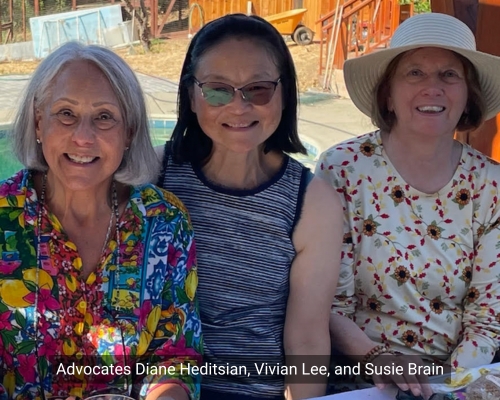
This blog is the fourth in a series about an ongoing study that examines how environmental exposures to chemical mixtures may contribute to breast cancer risk (the first blog explains the study, the second explains non-targeted analysis, and the third explains DNA methylation). The study is led by Dr. Kimberly Badal from the University of California, San Francisco. In addition to collaborating with other researchers, Dr. Badal’s study prioritizes collaboration with breast cancer research advocates. The three advocates involved in this study are breast cancer survivors whose lived experience makes them uniquely suited to communicate the need for environmental breast cancer research and ensure that the research represents patient interests.
Zero Breast Cancer’s Lianna Hartmour had the opportunity to speak with advocates Vivian Lee, Susie Brain, and Diane Heditsian about why there is a need for advocate involvement in environmental breast cancer research. She also spoke with Dr. Badal to hear her perspective on how advocates inspired her research.
Why is there a need for advocates to get involved in environmental cancer research?
Public consciousness about environmental causes of cancer has existed since the 1960s when marine biologist Rachel Carson published Silent Spring, a book about the human health and environmental impacts of synthetic pesticides. However, over fifty years later, there is still a need for more research on environmental contributors to cancer. This is in part because studying environmental exposures has been limited by available technology and has traditionally been approached through the individual examination of potential carcinogens. This approach is not conducive to real world exposures where people are exposed to multiple chemicals at the same time, which is why Dr. Badal’s chemical mixtures research is so important.
Even in the face of these challenges, advocates work to champion environmental cancer research, spreading awareness about its necessity. Since 2012, breast cancer incidence in the United States has been increasing at a rate of about 1 percent per year (American Cancer Society, 2024). Rates of breast cancer in women younger than 50 have also been on the rise, with a rate of increase of 1.4 percent per year. Susie Brain highlighted these increasing rates in her interview, saying “It seems to me fairly obvious that we really don’t have enough information. We know that cancer incidence is high, especially in younger women. We must do the research to find out if this is due to our exposures to chemical toxins and other environmental factors.”
For many breast cancer patients, especially those whose disease is not coupled with an inherited genetic mutation or high lifestyle risk factors, diagnosis leads to questions about what could have caused the disease. Heditsian spoke of this speculation when asked why research on environmental exposure is important. She shared that many newly diagnosed women she talks with through her one-on-one patient advocacy asks the question of “Why did I get the disease when I have no inherited genetic [mutation], no family history, I eat a healthy diet, and I am passionate about exercise?"
That people have a right to know about the risks they experience through environmental contaminants has long been foundational to the environmental movement. Lee highlighted how environmental cancer research can contribute to the fulfillment of this core principle saying, “I think it’s important for patients to be educated on what kinds of environmental exposures have an impact on their risk of developing cancer.”
Dr. Badal attributes her inspiration to pursue this project to the persistence of advocates who want answers, saying that “They would constantly bring up the environment, so that kept it front and center in my mind.” Advocating for studying the environment in breast cancer research is only the first step in advocates’ involvement in the research process, but it is a very critical one. As Heditsian put it, “We can’t change the situation until we have the science.”
How do advocates benefit the research process?
Helping with the grant writing process
According to Dr. Badal advocates have been “integral from the beginning” of her chemical mixtures research project, starting with the grant writing process. Advocates who are breast cancer survivors help to weave a narrative into the grant proposal, making it more impactful to the reviewer. Heditsian says that one way she feels she makes a difference through her work is through “improving a grant application for a researcher by teaching her how to tell her research story so she’ll actually get the funds to do the research.”
In addition to bringing patient priorities and concerns to the grant proposal, advocates who are trained in the science of breast cancer but are not entrenched in it, are able to translate its jargon into language that is digestible to a lay audience.
Keeping patients at the center of the research
Having actually lived through the disease, one of the most important components of advocates’ work is to ask questions. Sometimes, questions advocates ask when working to better understand the research can spark new ideas for the researcher. Other times, advocates raise questions with the intention of keeping patients at the center of the research. For example, an advocate might ask, “how will this research lead to a benefit to the patient or the general public?” Dr. Badal refers to these questions as “so-what” questions and explained how they challenge her work in a positive way, saying “I think the hardest questions that I often get in doing research comes from the advocates because they ask very so-what questions, and sometimes it’s very hard to get to so-what when you’re down in the weeds of trying to make sure that the science is sound. It requires much more long-term thinking, global thinking.”
In addition to keeping patients central in the research through asking questions, Heditsian noted that advocates “also serve as a reminder, a physical reminder, of why the research is being done.”
How do advocates help take the research beyond the scientific community?
Just as individual advocates are key in bringing patient interests into the research, the strength of advocate organizations such as Zero Breast Cancer (ZBC) at the Collaborative for Health & Environment (CHE) is in their ability to amplify research. In her interview, Dr. Badal shared that from her perspective, “Zero Breast Cancer is adding a layer of value of having an organized advocacy organization working with you on a project.” She attributes this advantage to ZBC’s ability to reach more people due to their long-established following and practices of publishing information through blogs, webinars, social media posts, and videos.
Blogs such as this one are published not only on the ZBC website and social media, but highlighted on CHE platforms as well. As part of their missions to amplify environmental health research, ZBC and CHE’s websites publish educational resources on a variety of environmental health topics. This results in its audience being wide reaching, which helps ZBC’s content reach people, including researchers and the lay public, outside of the breast cancer community.
What hope is there for the future?
In speaking about the work Dr. Badal and other university researchers are doing, advocate Susie Brain said “It gives the whole environmental movement credibility which I think is really important.” Continued research on the environmental determinants of cancer can create a positive feedback loop in which research projects can be strengthened by not only the scientific knowledge they reveal, but the credibility they will together provide.
While the challenges surrounding environmental cancer research are plentiful, so are the opportunities for change. Dr. Badal remarked that the inclusion of advocates in her research was a recent change, saying “I did not have the privilege of working with advocates before I came to UCSF. I think it’s definitely a model of integration that needs to be adopted throughout the world in all research institutions that are working on human diseases.” Dr. Badal acknowledged that the inclusion of advocates in research is not always viable in low resource settings. She hopes the value of putting humans at the center of human disease research will come to be recognized so that advocates will routinely be included in all kinds of research.
This article was written by Camille Sytko, CHE Science Communications Intern